
Learning about money, investing, and financial markets can feel confusing when you are just starting. Stock prices change, new financial technologies appear, and investment terms are often difficult to understand. Online courses can make these subjects easier by organizing important concepts into lessons that learners can study at their own pace.
FintechZoom.io courses is a search term used by people looking for financial education, stock market learning, investing guidance, and practical money management skills. The website at FintechZoom.io currently lists courses covering financial literacy, stock market trading, and stock market investing. These programs are presented as online learning options for beginners and people who want to develop their financial knowledge.
However, before enrolling, it is important to understand what the courses claim to cover, how to evaluate their educational value, and how to verify the website’s identity. This guide explains the available course categories, their potential benefits, the subjects learners should understand, and the checks worth completing before making a payment.
What Are FintechZoom.io Courses?
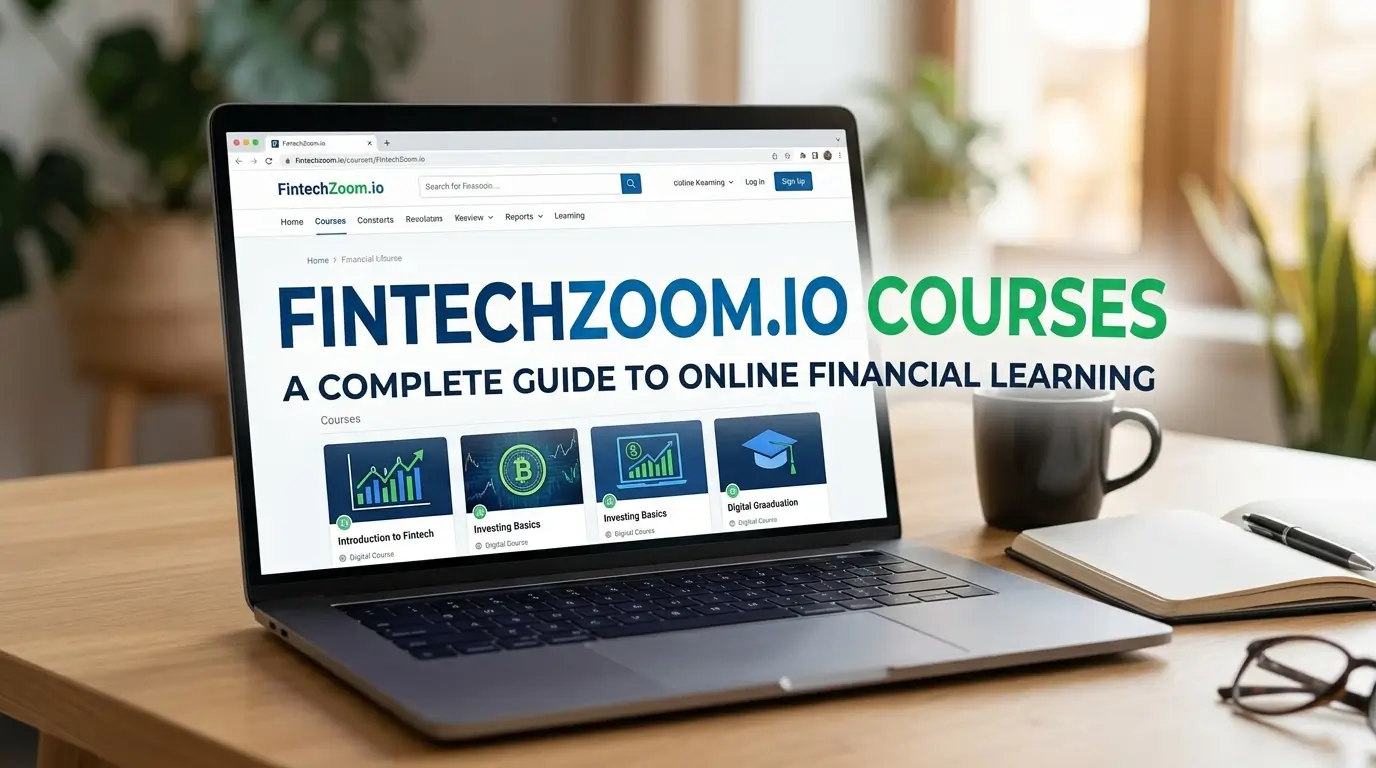
FintechZoom.io courses are educational programs advertised on the FintechZoom.io website. The published course pages focus mainly on personal finance, trading, and investment knowledge.
The general courses page describes a self-paced learning experience with practical examples, quizzes, learning materials, and support. It also mentions lifetime access and a 30-day satisfaction guarantee. These are claims made by the website, so learners should confirm the current terms directly before purchasing anything.
The three main course categories listed on the site are:
- Financial literacy.
- Stock market trading.
- Stock market investing.
Each category addresses a different learning goal. Financial literacy focuses on everyday money management, trading education covers buying and selling financial assets, and investing education focuses more broadly on building and managing an investment portfolio.
Choosing the right subject matters because understanding how to manage money is different from learning how to trade stocks or evaluate a long-term investment.
1. Financial Literacy Courses
Financial literacy is the ability to understand and manage money effectively. It includes knowing how to budget, save, borrow, manage debt, and make informed financial decisions.
The financial literacy course listed on FintechZoom.io describes lessons covering budgeting, savings, credit, debt management, financial planning, and basic investing.
These subjects are useful because financial decisions affect nearly every part of daily life. Someone who earns a regular salary, for example, may still struggle financially if they do not understand expenses, borrowing costs, or the importance of saving.
What Can You Learn From Financial Literacy?
A well-structured financial literacy program should explain several essential topics.
Budgeting and expense management: Learn how to compare monthly income with expenses, identify unnecessary spending, and create a realistic spending plan.
Saving money: Understand how to establish savings goals, prepare for unexpected expenses, and develop consistent saving habits.
Credit and debt: Learn how interest rates affect borrowing costs, why repayment schedules matter, and how to avoid taking on more debt than you can manage.
Emergency funds: Understand why keeping money available for unexpected expenses can reduce the need to borrow during difficult periods.
Financial goal setting: Learn to distinguish short-term goals, such as purchasing a laptop, from longer-term goals, such as retirement planning or buying a home.
Introduction to investing: Understand the basic differences between savings accounts, stocks, bonds, and other financial assets.
Who Should Consider Financial Literacy Education?
This subject can be useful for students, first-time earners, working professionals, and anyone who wants to improve their money management habits.
For example, a person earning a monthly salary might divide their income into essential expenses, savings, debt repayments, and discretionary spending. The exact percentages should depend on their income and responsibilities rather than a universal formula.
The main benefit of financial literacy is that it helps people make decisions with a clearer understanding of the consequences.
2. Stock Market Trading Courses
Stock market trading involves buying and selling shares or other financial instruments in an attempt to benefit from price movements.
The stock market trading course advertised on FintechZoom.io is presented as a program for people interested in trading strategies and financial market tools.
Trading can be more complicated than it first appears. Prices can move quickly in response to company announcements, economic reports, interest rates, and changes in investor expectations. A trader therefore needs more than an understanding of when prices rise or fall.
Important Topics in Trading Education
Understanding the stock market: Learn what stocks represent, how exchanges operate, and how buyers and sellers influence prices.
Market orders and limit orders: Understand the difference between an instruction to execute a trade at the available market price and an order that specifies a maximum purchase price or minimum selling price.
Price charts: Learn how to read basic charts, identify trends, and understand the limitations of technical indicators.
Trading strategies: Explore how different approaches use price movements, time frames, and market information. A strategy should be tested rather than accepted simply because it sounds convincing.
Risk management: Understand position sizing, stop-loss orders, and the importance of limiting the amount exposed to a single trade.
Trading psychology: Learn how fear, excitement, and overconfidence can influence decisions.
Is Trading Suitable for Beginners?
Beginners can study trading, but studying it does not mean they should immediately start risking money.
A sensible learning process begins with market fundamentals and simulated trading. A practice account allows learners to explore order types and trading platforms without committing real capital.
Even simulated trading has limitations. It cannot fully reproduce the emotional pressure, execution costs, or changing liquidity that may affect real transactions.
Anyone considering active trading should understand that losses are possible, and leverage can increase those losses substantially. No educational program can guarantee profitable trades.
3. Stock Market Investing Courses
Investing is different from short-term trading. Investors generally purchase assets with the intention of holding them for a longer period, although individual strategies and holding times vary.
The stock market investing course advertised on FintechZoom.io describes topics related to investment strategies, asset allocation, portfolio management, diversification, and financial goals.
These subjects can help learners understand how investments fit into a broader financial plan.
What Does Investment Education Cover?
Stocks and shares: Understand how owning shares gives an investor an ownership interest in a company and why share prices fluctuate.
Bonds: Learn how bonds work, how issuers borrow money from investors, and how interest rates and credit risk can affect bond prices.
Exchange-traded funds: Understand how ETFs can provide exposure to a collection of assets through a single investment product.
Diversification: Learn why spreading investments across different assets can reduce exposure to problems affecting a single company or sector.
Compounding: Understand how investment returns may generate additional returns over time, while recognizing that investment growth is never guaranteed.
Portfolio management: Explore how investors select assets, monitor risk, and review their portfolios as their goals change.
Market research: Learn how company earnings, economic conditions, interest rates, and other factors can influence investment decisions.
Why Is Long-Term Investing Different From Trading?
Consider two hypothetical people.
The first person buys a stock because they expect its price to increase over the next few days. They may monitor price charts frequently and make decisions based on short-term market movements.
The second person researches a company, evaluates its business performance, considers its valuation, and decides whether the shares fit a long-term investment plan.
Both approaches involve risk, but they require different methods of analysis and decision-making.
Investment education can help learners understand these differences before choosing an approach that matches their goals, time horizon, and ability to tolerate losses.
Comparing the Main FintechZoom.io Course Categories
The three advertised categories serve different purposes. The following comparison summarizes their intended focus.
| Course category | Main focus | Best starting point |
|---|---|---|
| Financial literacy | Budgeting, saving, credit, debt, and money management | People building basic financial skills |
| Stock market trading | Trading concepts, price movements, and risk management | People interested in active trading |
| Stock market investing | Portfolio building, asset classes, and long-term strategies | People learning about investments |
The table reflects the subjects described on the website. It should not be interpreted as an independent assessment of course quality or proof that learners will achieve particular results.
Before choosing a program, review its full syllabus, lesson samples, instructor information, and current price. These details can help you determine whether the material is suitable for your experience level.
What Learning Materials Are Advertised?
The course pages describe several learning features intended to support independent study.
On-Demand Video Lessons
The published course descriptions mention recorded video lessons that learners can watch at their own pace.
Video lessons can be helpful when a subject involves charts, calculations, or step-by-step explanations. Students can pause a lesson, revisit a difficult concept, and take notes before moving forward.
However, the number of videos or hours of content does not automatically determine educational quality. Clear explanations, accurate information, and useful exercises are more important than lesson length alone.
Printable Worksheets
The financial literacy and investment course pages mention downloadable worksheets.
Worksheets can help learners apply ideas rather than simply read about them. A budgeting worksheet, for example, may help someone list monthly income, recurring expenses, debt payments, and savings goals.
Before enrolling, check whether the actual materials are available for preview and whether they are detailed enough for practical use.
Quizzes and Exercises
Quizzes can help students identify concepts they have not fully understood.
For example, a quiz might ask learners to distinguish between a market order and a limit order or calculate the total interest paid on a loan.
Exercises are most useful when answers include explanations, allowing learners to understand why an answer is correct or incorrect.
Course Certificates
The website advertises certificates for certain courses. However, a certificate of completion should not automatically be treated as a professional qualification or an industry-recognized credential.
If you intend to use a certificate for employment, further education, or professional development, confirm who issues it and whether the relevant employer or institution recognizes it.
Is FintechZoom.io Courses Suitable for Beginners?
The website describes its courses as suitable for people with different levels of experience, including beginners. Nevertheless, suitability depends on the actual content, the quality of the teaching, and the learner’s objectives.
A beginner who wants to improve personal budgeting skills has different needs from someone who wants to understand stock valuation or active trading.
Before enrolling, consider the following questions:
- Does the course explain basic concepts before introducing advanced material?
- Are the lessons written or presented in language you understand?
- Are there practical examples or exercises?
- Does the syllabus match your learning goals?
- Can you preview any lessons before paying?
- Is the instructor’s background clearly explained?
- Are the total cost and refund conditions easy to understand?
If the answers are unclear, request more information before making a commitment.
A useful financial course should help students understand both opportunities and risks. Be cautious of programs that focus entirely on potential profits without discussing losses, fees, uncertainty, and realistic expectations.
Important Website Verification Before Enrolling
There is an important issue that readers should understand before purchasing any FintechZoom.io course.
The website at FintechZoom.com has published a warning stating that fintechzoom.io is not affiliated with its platform and includes the .io domain among websites it identifies as impersonating FintechZoom. You can read that warning on the FintechZoom.com official website information page. This is a material concern that prospective students should investigate before providing payment or personal information.
The existence of a course page on FintechZoom.io does not establish that the courses are authorized by, or connected to, the FintechZoom.com platform.
This does not independently establish every detail about the people operating the .io website or the quality of its educational content. It does mean that the relationship between the two websites should not be assumed.
How to Protect Yourself
Before registering or paying for a course, take these precautions:
- Verify the website identity. Contact the organization through contact details independently obtained from its established official website and ask whether it operates or endorses the course.
- Check the course provider. Look for the legal business name, instructor identities, qualifications, and a clear explanation of who provides the education.
- Read the payment terms. Confirm the total price, recurring charges if any, refund conditions, and payment recipient.
- Review the privacy policy. Understand what personal information is collected and how it may be used.
- Avoid guaranteed-profit claims. No legitimate educational course can guarantee that you will make money from trading or investing.
- Protect sensitive information. Never provide banking passwords, cryptocurrency recovery phrases, or unnecessary identity documents to a course provider.
The safest approach is to resolve the affiliation question before purchasing. A professional-looking website, course certificate, or collection of positive testimonials is not sufficient proof of legitimacy.
How to Get More Value From an Online Finance Course
If you choose a course after completing your checks, a consistent study routine can help you learn more effectively.
Set a Clear Learning Goal
Start by deciding what you want to understand.
For example, your goal might be to create a monthly budget, learn how stock exchanges operate, or understand the differences between stocks and bonds.
A specific goal makes it easier to select relevant lessons and measure your progress.
Study in Small Sections
Instead of trying to complete an entire course in one sitting, study one subject at a time.
After each lesson, write down the main ideas and identify any terms that remain unclear. Revisit difficult sections before continuing.
Practice What You Learn
Apply financial concepts to realistic examples.
You might create a sample household budget, compare the fees associated with different investment products, or use a simulated trading account to learn how orders work.
Practical exercises help turn unfamiliar concepts into useful knowledge.
Keep a Learning Journal
Record important definitions, questions, calculations, and lessons learned.
For trading or investing education, you can also document why a hypothetical decision was made and what risks were involved.
This encourages thoughtful analysis rather than impulsive decisions.
Review Your Progress
At the end of each week, review what you have learned and identify subjects that need more attention.
Do not measure progress only by how quickly you finish a course. Measure it by whether you can explain the concepts clearly and apply them correctly.
Alternatives to Consider for Financial Education
You do not necessarily need to purchase a course to begin learning about money and investing.
Depending on your goals, you can also explore educational resources from established financial regulators, universities, and recognized educational organizations.
For example, the U.S. Securities and Exchange Commission’s Investor.gov provides educational information about investing, investment products, and fraud prevention.
The FINRA investor education website offers resources explaining investment risks, accounts, and common financial decisions.
These resources can help you develop foundational knowledge and compare the information presented by commercial course providers.
If you are outside the United States, consider consulting the official financial regulator in your own country as well. Financial rules, tax treatment, and investor protections differ by jurisdiction.
Frequently Asked Questions
What Are FintechZoom.io Courses?
FintechZoom.io courses are online educational programs advertised on the website under financial literacy, stock market trading, and stock market investing. The website describes features such as recorded lessons, exercises, and learning support. Prospective students should independently verify the provider’s identity and course terms before enrolling.
What Subjects Do These Courses Cover?
The published course descriptions mention budgeting, saving, debt management, stock market trading, investment strategies, portfolio diversification, and financial planning. The exact subjects and materials should be confirmed by reviewing the relevant course syllabus.
Are FintechZoom.io Courses Free?
The public course descriptions reviewed do not establish a clear, current price for every program. Check the relevant course page and confirm the full cost before proceeding. Do not assume that a course is free simply because introductory information is available online.
Can Beginners Learn Stock Market Investing Online?
Yes. Beginners can learn basic concepts such as stocks, bonds, ETFs, diversification, and risk management through online educational resources. However, understanding these subjects does not guarantee profitable investments.
Do Course Certificates Guarantee Employment?
No. A certificate may demonstrate that you completed a particular program, but it does not guarantee employment or professional recognition. Check the issuing organization and the requirements of any employer or institution where you plan to use the certificate.
Is FintechZoom.io Officially Connected to FintechZoom.com?
FintechZoom.com has published a warning stating that fintechzoom.io is not affiliated with its platform. Readers should take this warning seriously and independently verify the course provider before sharing personal information or making a payment.
Can an Online Trading Course Guarantee Profits?
No. Financial markets involve uncertainty, and trading can result in significant losses. Educational material can help explain trading concepts and risk management, but it cannot guarantee future market performance or investment returns.
Conclusion
FintechZoom.io courses are presented as online learning options for people interested in financial literacy, stock market trading, and investing. Each subject can help learners develop a better understanding of money and financial markets when the educational material is accurate, practical, and appropriate for their experience level.
Financial literacy can help people manage income, spending, and debt. Trading education can introduce market mechanics and risk management, while investment education can explain asset classes, diversification, and long-term portfolio planning.
However, the most important consideration is not simply what a course promises to teach. Learners should also verify who operates the website, review the course syllabus, check the instructor’s qualifications, understand the payment and refund terms, and avoid any claims of guaranteed profits.
Because FintechZoom.com has explicitly warned that fintechzoom.io is not affiliated with its platform, prospective students should resolve that identity concern before enrolling.
The best financial education helps you ask better questions, understand the risks, and make informed decisions. Take your time, compare reliable resources, and choose learning materials based on their actual educational value rather than promises of quick financial success.