
Choosing a new mattress can feel surprisingly difficult. There are many materials, firmness levels, prices, and designs to consider, but two options appear again and again: memory foam and hybrid mattresses.
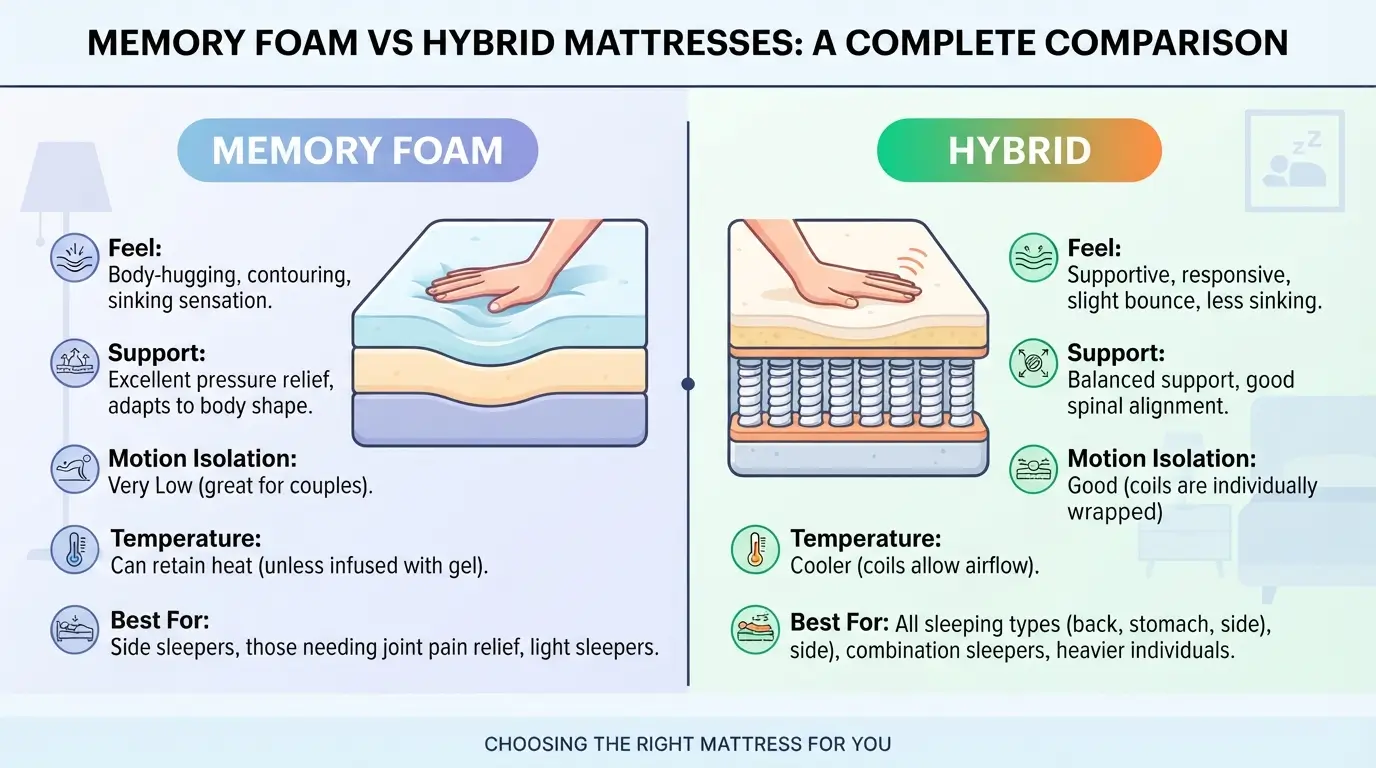
If you are trying to decide between them, a clear table comparing memory foam vs hybrid mattresses can make the differences much easier to understand. Both types can provide comfortable sleep, but they achieve that comfort in different ways.
Memory foam mattresses are made mainly from layers of foam. They are known for their body-contouring feel and pressure relief. Hybrid mattresses combine foam with an inner-spring support system, giving them a mixture of cushioning, support, and responsiveness.
Neither design is automatically right for everyone. Your sleeping position, body weight, preferred firmness, temperature preferences, and budget can all affect which mattress feels better.
This guide explains the main differences in simple terms so you can make a more informed choice.
What Is a Memory Foam Mattress?
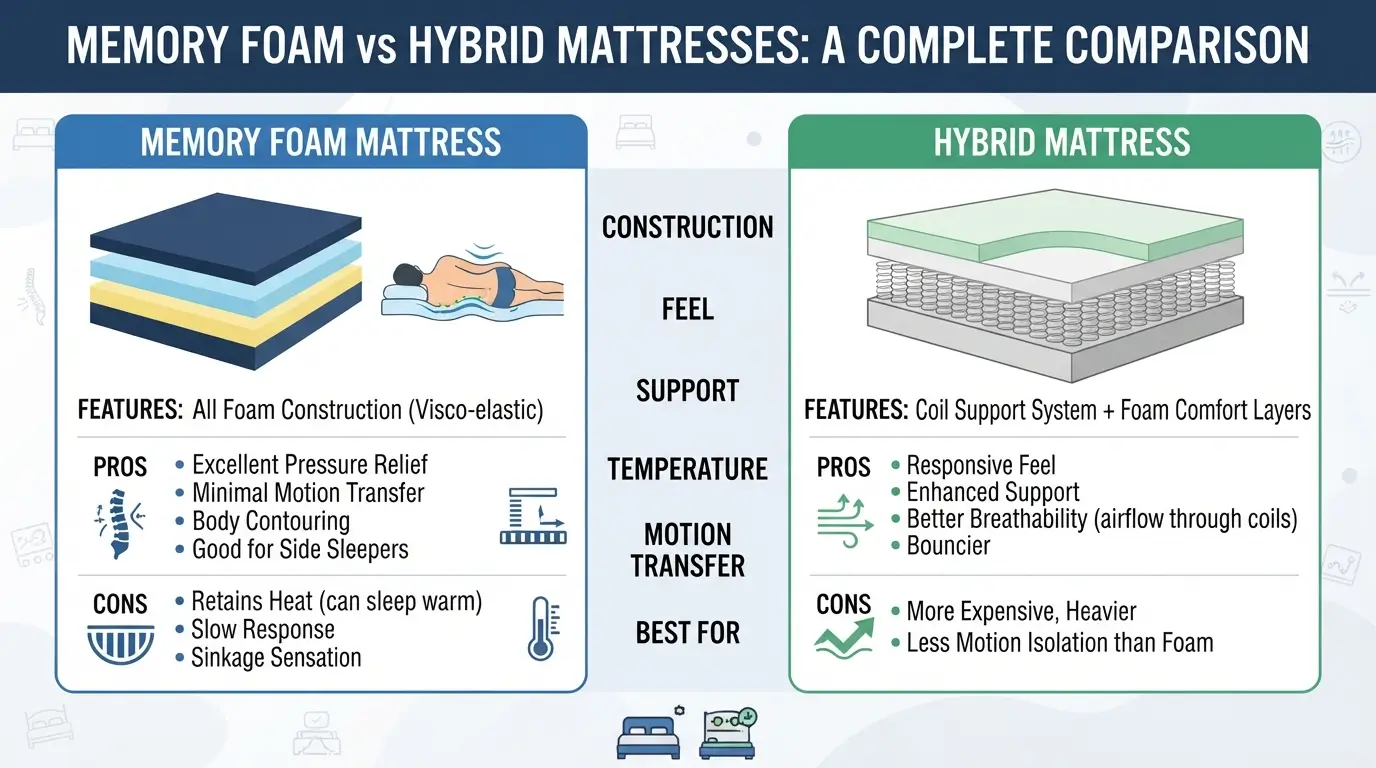
A memory foam mattress uses layers of foam to create its support system. The top layer is usually made from memory foam, while additional foam layers underneath provide structure and stability.
Memory foam was originally developed by NASA in the 1960s for aircraft seating. Over time, the material became widely used in mattresses, pillows, and other comfort products.
The most noticeable feature of memory foam is its ability to respond to body heat and pressure. When you lie down, the foam gradually conforms to your body. When you get up, it slowly returns toward its original shape.
This creates the familiar feeling of being gently surrounded by the mattress.
For people who enjoy a softer, more cushioned sleeping surface, memory foam can be appealing. It can also reduce pressure around areas such as the shoulders and hips.
What Is a Hybrid Mattress?
A hybrid mattress combines two major components: foam and a coil support system.
The comfort layers may contain memory foam, latex, polyurethane foam, or a combination of materials. Beneath those layers are individually wrapped or interconnected coils that provide the main support structure.
The goal is to combine the cushioning of foam with the responsive support of springs.
When you lie on a hybrid mattress, the comfort layers provide some contouring, while the coils help prevent you from sinking too deeply.
This design can feel more responsive than an all-foam mattress. It is often appealing to people who like the comfort of foam but still want the traditional bounce associated with an innerspring mattress.
Memory Foam vs Hybrid Mattress Comparison
The following table gives you a quick overview before we look at each difference in more detail.
| Feature | Memory Foam Mattress | Hybrid Mattress |
|---|---|---|
| Construction | Mainly foam layers | Foam plus coil support |
| Feel | Contouring and hugging | Cushioned with more bounce |
| Pressure Relief | Usually excellent | Usually very good |
| Motion Isolation | Excellent | Good to very good |
| Edge Support | Depends on design | Often stronger |
| Responsiveness | Lower | Higher |
| Airflow | Can be limited | Usually better |
| Temperature | Some models sleep warm | Often cooler |
| Ease of Movement | Can feel slower | Usually easier |
| Weight | Often lighter | Usually heavier |
| Durability | Depends on foam quality | Depends on foam and coil quality |
| Price | Available across many price ranges | Often more expensive |
| Best For | Pressure relief and motion isolation | Balance of support, bounce, and airflow |
The table shows why there is no universal winner. Each mattress type has strengths that suit different sleepers.
Memory Foam vs Hybrid: Comfort and Feel
Comfort is one of the most personal parts of choosing a mattress.
Memory foam typically gives you a close-fitting sensation. When you lie down, the foam molds around your body. Some people describe this as feeling like the mattress is gently holding them in place.
Hybrid mattresses usually feel more responsive. The foam provides cushioning, while the coils push back against your body.
If you prefer a mattress that feels soft and enveloping, memory foam may be more appealing. If you like to move around easily and prefer some bounce, a hybrid may feel more natural.
Of course, firmness also matters. A firm memory foam mattress can feel completely different from a soft memory foam model, just as a plush hybrid can feel very different from a firm hybrid.
Pressure Relief
Pressure relief is especially important for people who sleep on their sides.
When you sleep on your side, your shoulders and hips carry a large portion of your body weight. A mattress that does not provide enough cushioning can create uncomfortable pressure in those areas.
Memory foam is well known for contouring around pressure points. Because the material conforms closely to the body, it can distribute pressure across a larger area.
Hybrid mattresses can also provide strong pressure relief, particularly when they have thick comfort layers. However, the exact experience depends heavily on the type and amount of foam used.
If pressure relief is your main concern, don’t judge a mattress only by whether it is called a hybrid or memory foam mattress. Look at the actual construction and firmness as well.
Motion Isolation
Motion isolation matters most for couples.
Imagine one person gets out of bed at 2 a.m. If the mattress transfers that movement across the sleeping surface, the other person may feel it.
Memory foam generally performs very well in this area because foam absorbs movement instead of transferring it through a connected spring system.
Hybrid mattresses can also provide good motion isolation, especially when they use individually wrapped coils. However, they may transfer slightly more movement than a dense all-foam design.
If you are a light sleeper sharing a bed, memory foam may be worth considering because of its ability to reduce movement across the surface.
Temperature and Sleeping Cool
Some people naturally sleep hot, and mattress construction can affect how comfortable they feel during the night.
Traditional dense memory foam can retain more heat because the material surrounds the body and has less open space for air movement.
Modern memory foam mattresses may address this issue with materials such as gel-infused foam, open-cell foam, cooling covers, or ventilated layers. However, the effectiveness varies between models.
Hybrid mattresses often have an advantage in airflow because the coil system creates more internal space. Air can move through those spaces more easily than through a dense block of foam.
If you regularly wake up feeling too warm, a well-ventilated hybrid may be worth considering.
Edge Support
Edge support describes how stable the mattress feels when you sit or sleep near its outer edge.
This feature can be useful for couples, people who move around during sleep, and anyone who has difficulty getting in and out of bed.
Hybrid mattresses often have stronger edge support because their coil systems can be reinforced around the perimeter.
All-foam mattresses can also have good edge support, but the experience varies considerably by design.
If you regularly sit on the side of your mattress, pay close attention to edge construction rather than assuming all mattresses will perform the same way.
Ease of Movement
A mattress that allows easy movement can be important if you frequently change sleeping positions.
Memory foam can have a slower response. When you move, the foam may take a moment to adjust to your new position.
Some sleepers love this because it creates a secure, stable feeling. Others find it restrictive.
Hybrid mattresses usually respond more quickly because the coils push back as you move. This makes changing positions easier for many people.
Combination sleepers who move between their back, side, and stomach during the night may appreciate this responsiveness.
Which Mattress Is Better for Side Sleepers?
Side sleepers often need enough cushioning around the shoulders and hips.
Memory foam can be a strong option because of its contouring ability. A medium or medium-soft model may allow the shoulders and hips to sink into the comfort layer while still providing support underneath.
A hybrid mattress can also work very well for side sleepers if it has sufficient cushioning.
The key is finding the right balance. A mattress that is too firm may create pressure around the shoulders. One that is too soft may allow the body to sink too deeply.
Which Mattress Is Better for Back Sleepers?
Back sleepers generally need a mattress that supports the natural alignment of the body.
A medium-firm mattress is often a useful starting point, although personal preference and body type matter.
Memory foam can provide good support by contouring around the lower back. Hybrid mattresses can provide a stronger responsive feel that some back sleepers prefer.
When lying on your back, you should feel supported rather than as though your hips are sinking deeply into the mattress.
Which Is Better for Stomach Sleepers?
Stomach sleepers usually need enough support to prevent the midsection from sinking too deeply.
A mattress that is too soft can make the body feel out of alignment.
For this reason, some stomach sleepers prefer firmer mattresses. Hybrid designs can be attractive because their coil systems provide responsive support.
A firmer memory foam mattress can also work, but the specific firmness and construction are important.
Memory Foam vs Hybrid for Couples
Couples often have different sleeping preferences.
One person might prefer a soft mattress while the other wants something firmer. One sleeper may move frequently while the other stays relatively still.
Memory foam is particularly good at reducing motion transfer, which can make it attractive for couples.
Hybrids provide a balance between motion isolation and responsiveness. They may also offer stronger edge support, which gives couples more usable sleeping space.
If both people have similar preferences, the decision becomes easier. If their preferences are very different, a mattress with balanced firmness and good motion isolation may be a better compromise.
Durability and Lifespan
How long a mattress lasts depends on its materials, construction, usage, and care.
A high-quality memory foam mattress can last for years when properly supported and maintained. However, lower-quality foam may develop body impressions or lose its original feel sooner.
Hybrid mattresses have both foam and coils, so their durability depends on the quality of both components.
A mattress with high-quality coils and durable comfort materials can provide long-term support, but a hybrid is not automatically more durable simply because it contains springs.
When shopping, look beyond the mattress type. Pay attention to material quality, warranty terms, construction details, and manufacturer reputation.
Which Mattress Is Easier to Move?
Memory foam mattresses are often lighter than hybrid mattresses, although modern foam mattresses can still be quite heavy.
Hybrid mattresses tend to be heavier because of their metal coil systems.
If you frequently move homes or need to rotate your mattress yourself, weight may be worth considering.
A lighter mattress is generally easier to handle, but this should not be the only factor in your decision.
Price Differences
Both memory foam and hybrid mattresses are available at different price levels.
Basic memory foam mattresses can be relatively affordable, while premium models with advanced foam materials can cost considerably more.
Hybrid mattresses often cost more because they combine multiple materials and include a coil support system. However, there are budget-friendly hybrid options as well.
Instead of choosing solely based on price, compare what you are actually getting for your money. Construction quality, materials, warranty coverage, and expected durability can matter more than the initial price tag.
How to Choose Between Memory Foam and Hybrid
If you are still unsure, think about how you sleep every night.
Ask yourself whether you prefer a mattress that hugs your body or one that feels more responsive. Consider whether you sleep hot, whether you share the bed, and how often you change positions.
Memory foam may suit you if you prioritize deep contouring, pressure relief, and excellent motion isolation.
A hybrid may be worth considering if you want a combination of cushioning, support, airflow, edge stability, and easier movement.
Your sleeping position should also influence the decision. Side sleepers may want more cushioning, while stomach sleepers often benefit from stronger support.
Final Thoughts
Choosing between memory foam and a hybrid mattress ultimately comes down to how you sleep and what you want from your bed.
A table comparing memory foam vs hybrid mattresses makes the basic differences easy to see, but the details matter. Memory foam is known for its contouring comfort, pressure relief, and strong motion isolation. Hybrid mattresses combine foam cushioning with coils, creating a more responsive feel and often providing better airflow and edge support.
Neither option works perfectly for every person. The right choice depends on your preferred firmness, sleeping position, temperature preferences, budget, and whether you share your bed.
Before buying, check the mattress construction rather than relying only on its name. Look at the type of foam, coil design, firmness, thickness, edge support, warranty, and trial period.
Most importantly, choose a mattress that supports your body comfortably and allows you to wake up feeling rested. A mattress is something you use every night, so taking a little extra time to understand the differences between memory foam and hybrid designs can make the buying decision much easier.