
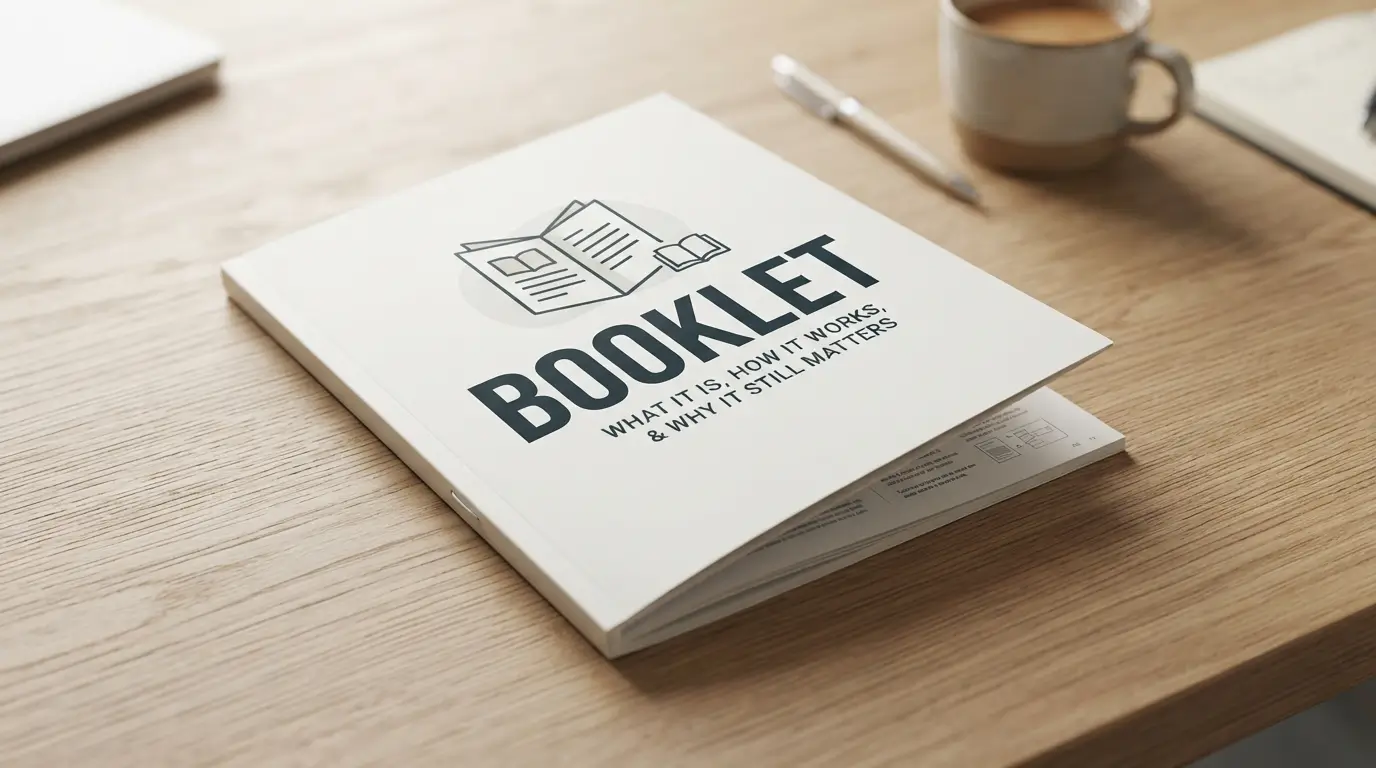
A booklet may look simple, but it can be one of the most useful ways to share information. From product guides and event programs to school projects, business brochures, instruction manuals, and small catalogs, booklets are used in many areas of everyday life.
Unlike a single sheet of paper, a booklet gives you enough space to explain a subject without making the reader deal with a large book. It sits somewhere between a flyer and a full-length publication. That balance is one of the main reasons booklets remain useful even in a world where most information is available online.
A well-made booklet can introduce a business, explain a service, teach a skill, present a product, or provide important information in a format that people can easily carry around. It can also be printed in small quantities, making it practical for individuals, schools, organizations, and small businesses.
In this guide, we will look at what a booklet is, the different types available, how booklets are made, where they are used, and what makes a booklet useful and attractive.
What Is a Booklet?

A booklet is a small printed publication made up of several pages that are usually folded and secured together. It is generally smaller and shorter than a traditional book.
The pages may be held together with staples, glue, thread, or another binding method. Some simple booklets are created by folding sheets of paper and securing them in the middle. Others can have a more professional appearance with a thicker cover and high-quality printing.
The size of a booklet can vary. Some are small enough to fit easily into a pocket, while others are closer to the size of a standard magazine. The best size depends on what the booklet is designed to accomplish.
For example, an event program may be compact so visitors can carry it throughout the day. A product catalog may be larger because it needs space for photographs, descriptions, prices, and other details.
Why Are Booklets Still Popular?
Digital content has changed the way people consume information, but printed material has not disappeared.
A booklet gives readers something physical that they can hold, read, save, and share. It does not require a phone, computer, internet connection, or battery. Someone can pick it up and start reading immediately.
This can be especially useful at events, stores, schools, exhibitions, conferences, and public locations.
A booklet can also make information feel organized. Instead of giving someone several loose pages, you can place the content in one compact publication.
Businesses often use booklets because they can explain their products or services in more detail than a basic flyer. A flyer may have enough room for a headline, image, and contact information, while a booklet can include several pages of useful information.
Common Types of Booklets
There is no single type of booklet. Their design and purpose can be completely different depending on the audience.
Product Booklets
Product booklets are commonly used by businesses to explain what they sell. They may contain product photographs, descriptions, specifications, prices, and information about available options.
A furniture company, for example, might create a booklet showing different collections and explaining the materials used in each product.
Instruction Booklets
Instruction booklets explain how to use a product, service, device, or system.
These publications need to be especially clear because readers are usually looking for a specific answer. Simple headings, illustrations, numbered steps, and short explanations can make an instruction booklet much easier to follow.
Event Booklets
Events often use booklets to provide schedules and useful information to visitors.
A conference booklet might include speaker details, session times, room numbers, maps, and sponsor information. A wedding program might introduce the people involved in the ceremony and provide the day’s schedule.
Educational Booklets
Schools, teachers, training organizations, and educational institutions can use booklets to explain lessons or provide learning material.
An educational booklet may focus on one subject and include explanations, examples, exercises, diagrams, and questions.
Because the information is collected in one place, students can keep the booklet and refer to it later.
Business Booklets
A business booklet can introduce a company to potential customers or clients. It may explain the company’s history, services, products, values, and contact information.
This type of booklet is often more detailed than a business card or basic brochure.
Booklet vs. Brochure
People sometimes use the words booklet and brochure as if they mean exactly the same thing, but there is a practical difference.
A brochure is often a single sheet that has been folded into multiple sections. It can be used to present information quickly and visually.
A booklet normally contains multiple pages that are bound or folded together.
The distinction is not always strict. Printing companies may use different terminology, but the basic idea remains useful: a brochure is often designed for quick information, while a booklet usually provides more room for detailed content.
How Is a Booklet Made?
Creating a booklet starts with planning.
Before anything is printed, the creator needs to decide what information belongs in the publication and who will read it. This affects the writing style, page size, images, colors, and overall design.
The content is then arranged across the pages.
Page order is important because booklets are often printed on both sides of sheets of paper and then folded. If the pages are not arranged correctly before printing, the finished booklet may appear in the wrong order.
Once the design is complete, the booklet can be printed and assembled.
Common binding methods include saddle stitching, perfect binding, and other forms of binding. The best method depends on the number of pages, paper thickness, budget, and desired appearance.
Choosing the Right Paper
Paper has a major effect on how a booklet looks and feels.
Thin paper is often suitable for simple information booklets, instruction material, or publications designed to keep costs low.
Thicker paper can create a more premium appearance. It is often used for covers, product catalogs, company publications, and promotional material.
The finish also matters. Glossy paper can make photographs and colorful graphics stand out, while matte paper can provide a softer appearance and reduce reflections when reading.
There is no single paper type that works for every booklet. The right choice depends on the purpose of the publication.
What Makes a Good Booklet?
A good booklet is not simply a collection of pages. It needs to be easy to understand and comfortable to read.
The first thing to consider is the reader. Think about what information they actually need and organize the content around that purpose.
Clear headings help readers find information quickly. Short paragraphs prevent pages from becoming overwhelming. Images can explain ideas that are difficult to describe with words alone.
Typography is also important. Text should be large enough to read comfortably, and the fonts should be consistent throughout the publication.
A strong booklet normally has a clear beginning, useful middle sections, and a conclusion or final page that tells readers what to do next.
Using Images in a Booklet
Images can make a booklet much more engaging.
A product booklet may use photographs to show products from different angles. An educational booklet may use diagrams to explain a difficult concept. An event booklet may use photographs to create a visual connection with the event.
However, images should have a purpose. Filling every empty space with pictures can make the publication look crowded.
High-quality images should be used whenever possible. Blurry or stretched images can make even an otherwise professional booklet look poor.
Writing Content for a Booklet
Writing for a booklet is different from writing a long book.
Readers usually want information quickly, so the language should be direct and easy to understand.
Avoid unnecessary words and complicated sentences. Explain important ideas clearly and use examples when they make the subject easier to understand.
For example, instead of writing a long technical explanation about a product, a product booklet could explain what the product does, who it is for, what makes it useful, and how to use it.
The goal is not to fill every page. The goal is to make every page useful.
How Businesses Can Use Booklets
Businesses can use booklets in many different ways.
A new company can use one to introduce its services to potential customers. A restaurant can create a booklet explaining its menu and story. A travel company can produce destination guides. A real estate business can create property information booklets.
Booklets can also be useful at trade shows and exhibitions. Instead of giving visitors several loose documents, a business can provide one organized publication containing the most important information.
A customer may keep the booklet for days or weeks after receiving it, giving the business another opportunity to remain memorable.
Booklets for Schools and Students
Schools can benefit from booklets because they are inexpensive and easy to distribute.
Teachers can create short booklets for individual subjects, revision material, classroom activities, or special projects.
Students can also create their own booklets as part of assignments. Making a booklet requires them to organize information, select important facts, and present ideas in a logical order.
This makes the format useful not only as a reading tool but also as a learning activity.
Digital Booklets
A booklet does not always have to be printed.
Digital booklets are commonly created as PDF files. They can be shared through websites, email, messaging platforms, or online learning systems.
A digital booklet can include clickable links, videos, interactive elements, and other features that are not possible with traditional paper.
Even so, the basic principles remain the same. Information should be organized clearly, pages should be easy to navigate, and the design should support the content.
Benefits of Using a Booklet
One major benefit of a booklet is its compact size. It provides more information than a flyer without requiring the reader to carry a full book.
Booklets are also flexible. They can be used for education, marketing, entertainment, instructions, events, and many other purposes.
Another advantage is their physical nature. A printed booklet can be handed directly to someone, placed on a desk, included with a product, or distributed at an event.
They can also be customized. Different paper sizes, covers, fonts, photographs, illustrations, and binding methods can be combined to create a publication that fits a specific purpose.
How Much Does a Booklet Cost?
The cost depends on several factors.
The number of pages, paper quality, color printing, quantity, binding method, and finishing options can all affect the final price.
Printing a larger number of copies often reduces the average cost per booklet, while small custom orders may cost more per unit.
Digital booklets can be cheaper because there is no printing or physical delivery cost.
For someone creating a booklet for the first time, it is useful to compare several printing options before placing an order.
Tips for Creating a Professional Booklet
Start with a clear purpose. Know exactly what the booklet should accomplish before writing the content.
Keep the design consistent from the first page to the last. Use a small number of fonts and maintain a consistent style for headings, body text, images, and captions.
Do not overcrowd the pages. Empty space can make information easier to read and can give the design a cleaner appearance.
Always check spelling, grammar, page numbers, images, contact information, and links before printing.
It is also a good idea to print one test copy before ordering a large quantity. A physical proof can reveal problems that are easy to miss on a computer screen.
The Future of Booklets
The role of printed booklets may continue to change as digital communication becomes more common, but the format is unlikely to disappear completely.
Physical publications remain useful in situations where people need something they can carry, read without a device, or keep for future reference.
At the same time, digital booklets provide a convenient way to distribute similar information online.
The two formats can also work together. A printed booklet can include a QR code that sends readers to a website, video, online catalog, or registration page.
This combination allows a simple booklet to connect the physical and digital worlds.
Final Thoughts
A booklet is a simple format with a surprisingly wide range of uses. It can educate students, introduce a business, explain a product, guide customers, organize an event, or provide useful information in a convenient form.
The best booklets are not necessarily the ones with the most pages or the most expensive designs. They are the ones that understand their audience and present useful information clearly.
Whether you choose a printed booklet, a digital PDF, or a combination of both, good planning, readable writing, thoughtful design, and useful content will always matter.
As communication continues to change, the booklet remains a practical way to bring information together in one organized and accessible publication.